Motion Composites · rigid aluminum
Apex
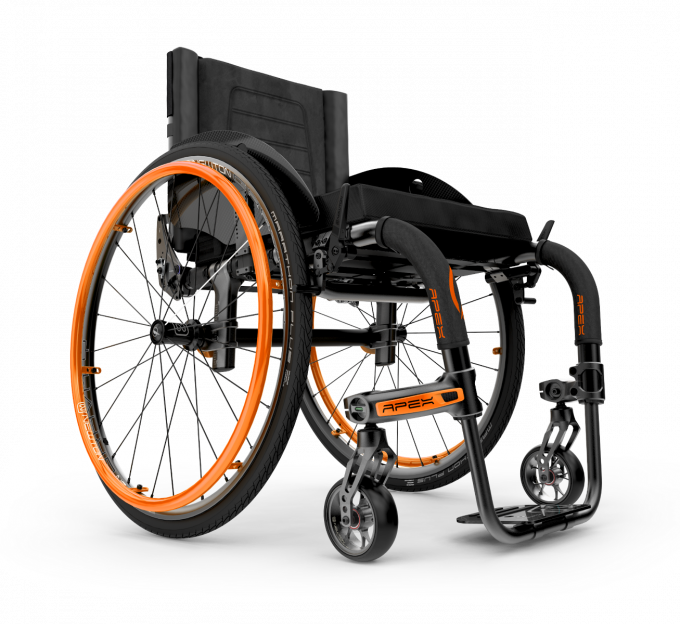
The Apex is a fully-adjustable rigid aluminum cantilever — the efficiency and stiffness of a rigid frame without giving up the ability to fine-tune your fit later. With no cross-brace to flex, every push goes forward instead of into the frame. Configure it below with live weight, estimated overall width, and price.
Body-Fit Dimensions
These measurements set how the chair fits your body. Most are fixed at build time — take a minute to get them right.
The internal frame width — the single dimension that drives overall width.
How to measure / choose
Sit on a firm, flat surface and measure across the widest point of your hips or thighs. Add ½–1" of clearance. Too wide forces an inefficient, shoulder-stressing push arc; too narrow causes pressure at the outer hips. This is fixed at time of build — get it right.
How far the seat extends under your thighs.
How to measure / choose
Sit with your back against a wall and measure from the wall to the crease behind your knee, then subtract 1–2" of clearance. Too deep cuts off circulation behind the knee; too shallow tilts the pelvis forward and puts too much pressure on your sitting bones.
Fine-tunes how far the frame reaches past the end of your seat upholstery before it bends down to the footrest, independent of Seat Depth. No charge either direction.
How to measure / choose
Seat Depth above is the length of the seat upholstery itself — this is different. Frame Length is how far the bare frame extends past the end of that upholstery before it angles down to the footrest. Longer opens up more room between the edge of your cushion and the footrest bend — helpful for longer lower legs, limited knee bend, or edema. Shorter tucks the footrest in closer for a tighter turning circle and a more compact footprint. Standard fits most riders — only move off it if you specifically need the extra or reduced room.
Front seat height — sets whether your feet rest flat with thighs parallel to the seat.
How to measure / choose
With your shoes on, measure from the floor to the back of your knee while seated, then account for cushion thickness. Too high lifts your thighs off the seat and increases pressure on your sitting bones; too low lets your feet drag. Adjustable in fine increments, so small corrections are easy to make.
Rear seat height — combined with front height it sets the seat slope ("dump").
How to measure / choose
Usually set 1–3" lower than the front height to create rearward seat slope ("dump"), which improves pelvic stability and propulsion. Constrained by rear wheel size and axle position — if your chosen combination isn’t achievable, I’ll flag it before your chair is built.
Sets which footrest hardware range fits — defaults to 2" less than your front height, editable.
How to measure / choose
Measured from the seat surface down to the footplate. As a rule of thumb this defaults to 2" less than your front seat-to-floor height, but you can change it — get up in your existing chair or a fitted one and measure directly if you have one. A standard footplate covers 12"–19"; a shorter length of 7"–13" needs the high-mount footplate (chosen under Footplates). The exact length requested may not be available depending on the rest of your configuration.
Official Motion Composites documents — the same brochure, order form, accessories guide, owner’s manual, and warranty terms we work from. Frame and cross-brace are covered by a limited lifetime warranty against manufacturing defects (aluminum’s disclosed expected service life is 5 years); components are covered for 1 year.
- Daryl reviews your exact configuration. Before anything is built, a clinician-led check confirms the setup makes sense for your body and goals — and we reach out directly with any concerns or suggested adjustments.
- It’s built to your measurements. Because each Apex is custom-built to order, it is non-returnable. Most parameters, however, remain adjustable after delivery, and the chair is upgradable down the line (wheels, casters, backrest, and more).
- A follow-up call is included. After your chair arrives you get a video or audio session to dial in axle position, seat slope, and fit — so the chair works the way it should from day one.
- Weight and width shown here are estimates. Frame weight (10.6 lb) and option prices are accurate; component weights and overall width are clearly-labeled estimates. We confirm the final overall width against Motion Composites’ official calculator before your order is placed.
Not sure where to start? Learn how to measure, try the Fit Wizard, or see what comes with every order.